
Taking care of your knife
Bring your knives to me and I’ll give them a new lease of life!
I sharpen your knives following the precise steps taught to me by the cutlery specialists from Thiernon.
You can contact me if you need a blade, spring or handle that has become too worn to be repaired. We’ll discuss the feasibility together.
The art of looking after your handcrafted knife
A high-quality knife deserves special care to ensure it lasts for years whilst retaining its sharpness and appearance. Here are my tips for looking after your knife on a daily basis.
The golden rule: cleaning the blade
‘You don’t wash a knife – you wipe it!’
- Do not: never put your knife in the dishwasher or run it under the tap.
- The correct method: wipe the blade with a slightly damp cloth or tea towel, then dry it thoroughly.
- Preventing rust: carbon steel blades are highly susceptible to oxidation. After each use and once dry, apply a thin layer of oil (linseed, olive or cooking oil). In a marine or very damp environment, treat stainless steel blades as well, as they can also rust.
- If the item comes into contact with salt water: rinse immediately with fresh water, dry it and then oil it generously.
Caring for the handle and the bolsters
- Wooden handle: wood may dry out, darken or swell. Treat it regularly with linseed oil or olive oil. If it is badly damaged, sand it lightly and evenly with very fine sandpaper (P400 grit) before polishing it with oil. Never immerse it in water.
- Horn handle: sensitive to heat (do not exceed 50 °C; take care with vehicles left in the sun) and moisture. Treat it in the same way as wood to prevent the material from drying out or warping.
- Bolsters: for stainless steel bolsters, care for them in the same way as the blade. If they are made of brass, use a suitable polishing product (such as Miror).
Pivot, mechanism and storage of the folding knife
- Mechanism and axles: regularly grease the axle by moving it back and forth to ensure the lubricant penetrates properly, then wipe off any excess to avoid staining your clothes. Clean the inside of the handle (dust, fibres) using a wooden toothpick to avoid scratches.
- Transport: to prevent scratches caused by keys or loose change, use a leather or felt case.
Sharpening or honing – that is the question?
Sharpening is the process of recreating or restoring a knife’s cutting edge when it has become worn or blunt. Honing, on the other hand, involves maintaining that cutting edge on a daily basis to ensure it remains effective.
This is an important distinction, because the most important thing about a knife is that it cuts. This may seem obvious, or even a truism, but how many good knives end up losing their effectiveness simply because they haven’t been honed?
Think of your butcher standing behind his counter. Between one customer and the next, between one cut and the next, what does he do? He hones his knife. In other words, he regularly maintains the edge to keep it sharp.
He doesn’t wait until the blade is completely blunt before resharpening his knife.
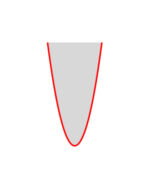
Sharpening involves removing the red part
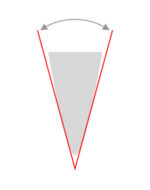
Honing involves maintaining the cutting edge
When it comes to sharpening, there are several tried-and-tested methods.
My method involves sanding the cutting edges, from heel to tip, using a 220-grit sanding strip. Alternate the sanding to remove material from both sides of the blade. Avoid overheating the blade so as not to compromise the heat treatment.
The blade should be sharpened evenly from the heel to the tip.
Once the cutting edge has appeared, stop grinding. Lightly run the cutting edge over a cotton pad coated with polishing paste to remove any burrs. Wipe with a leather cloth. The height of the cutting edge must not exceed 2 mm from heel to tip. Check the cutting quality.
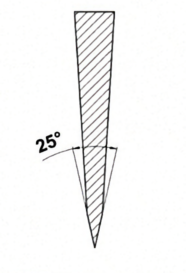
Flat profile. Both side faces are straight; the blade is thinner than that of the curved profile; the cutting capacity is increased, but impact resistance is reduced.
When it comes to honing, there are whetstones, sharpening rods and guides – to each their own method.
You must ensure the correct angle is maintained. There are tools available, such as the cross-pin module designed for professionals or the 3-step manual sharpener for home use.
Laurent Chabut